

For researchers, digital identity turns out to be far messier than having a single “about me” page. There’s an ORCID profile for a unique identifier across publishers, Google Scholar for citations, Scopus and Web of Science for the metrics institutions recognize, SINTA for Indonesian research contexts, and ResearchGate for networking with other researchers. Each platform serves a real purpose, but the result is an identity scattered across five different places, while a personal or institutional website is often left linking to each one individually, with no cohesive way to present them together.
Sample of Plugin

Publications
- Exploring digital behaviour among Indonesian farmers: the relation of digital literacy on information seeking and entertainment consumption Online Information Review (2026)
- Economic impacts of K-pop event tourism: a CGE-based assessment of IU’s concert in Indonesia International Journal of Event and Festival Management (2026)
- AI ADOPTION IN THE DIGITAL CREATIVE INDUSTRY: WHY TALENT READINESS OVERWEIGHS ORGANIZATIONAL SUPPORT? Jurnal Industri Kreatif dan Kewirausahaan (2025)
- Social media literacy among rural people in Indonesia: Empirical findings from a nationwide survey Information Development (2024)
- Understanding how governance arrangements within agricultural supply chains influence farmers' SAP adoption for adaptation and mitigation practices Agricultural Systems (2024)
- The Governance of Top-Level Domain (TLD) to Support Advancement of Internet Promotion and Innovation in Indonesia STI Policy and Management Journal (2024)
- Digital Literacy of Rural Areas in Indonesia: Challenges and Opportunities Proceedings of the 4th International Conference on Rural Socio-Economic Transformation, RUSET 2023, 1 November 2023, Bogor, Indonesia (2024)
- Resource-based typology to facilitate sustainable growth of agricultural start-up companies in ASEAN IOP Conference Series: Earth and Environmental Science (2024)
- Kajian Penyusunan Indeks Daya Saing Daerah 2022 (2023)
- Indeks Daya Saing Daerah 2022 BRIN Press (2023)
- The Long Journey of Indonesian Science and Technology Policy during The New Order Period (1968-1998) STI Policy and Management Journal (2022)
- Science and Technology Development in Dutch East Indies Indonesian Historical Studies (2022)
- The Absorpotion of HRST From Technology-Based Companies of Indonesia STI Policy and Management Journal (2021)
- The Response of Indonesian STI Actors in the Mitigation of COVID-19 MIMBAR : Jurnal Sosial dan Pembangunan (2021)
- Modul Teknis Penggunaan Mendeley dalam Penulisan KTI Unpublished (2016)
That gap is what led to Researcher Profile, a WordPress plugin that displays a researcher’s profile card through a single shortcode
Download
Researcher Profile is currently under review for the official WordPress.org Plugin Directory. Once approved, it will be installable directly from Plugins > Add New inside WordPress, or downloadable from
wordpress.org/plugins/researcher-profile.
or
Two Kinds of Data, One Reason
What sets this plugin apart isn’t just how the card looks, but how it treats two different kinds of data, and the reasoning behind that split is technical, not just a design choice.
Some data is entered manually: profile photo, display name, current position or affiliation, latest education, and links to Google Scholar, Scopus, Web of Science, SINTA, and ResearchGate profiles. All of these show up as outbound badges pointing to each platform.
Other data, specifically the publication list, can sync automatically, but only from ORCID. The reason is simple: of all the platforms mentioned, ORCID is the only one with an official public API. Scopus has an API, but it requires institutional or paid access. Google Scholar, Web of Science, and ResearchGate offer no public API at all, which means the only way to pull their data automatically is scraping, reading a web page as if a human were browsing it. That kind of scraping is fragile, breaks the moment a site’s layout changes, and in some cases violates the platform’s own terms of service.
For that reason, Researcher Profile deliberately does not try to pull data from those platforms automatically. Their links are pasted once and never break just because the site behind them changes. ORCID’s publication data, on the other hand, can rely on automation precisely because it comes through an official channel, with results cached periodically so the page stays fast.
How It Works
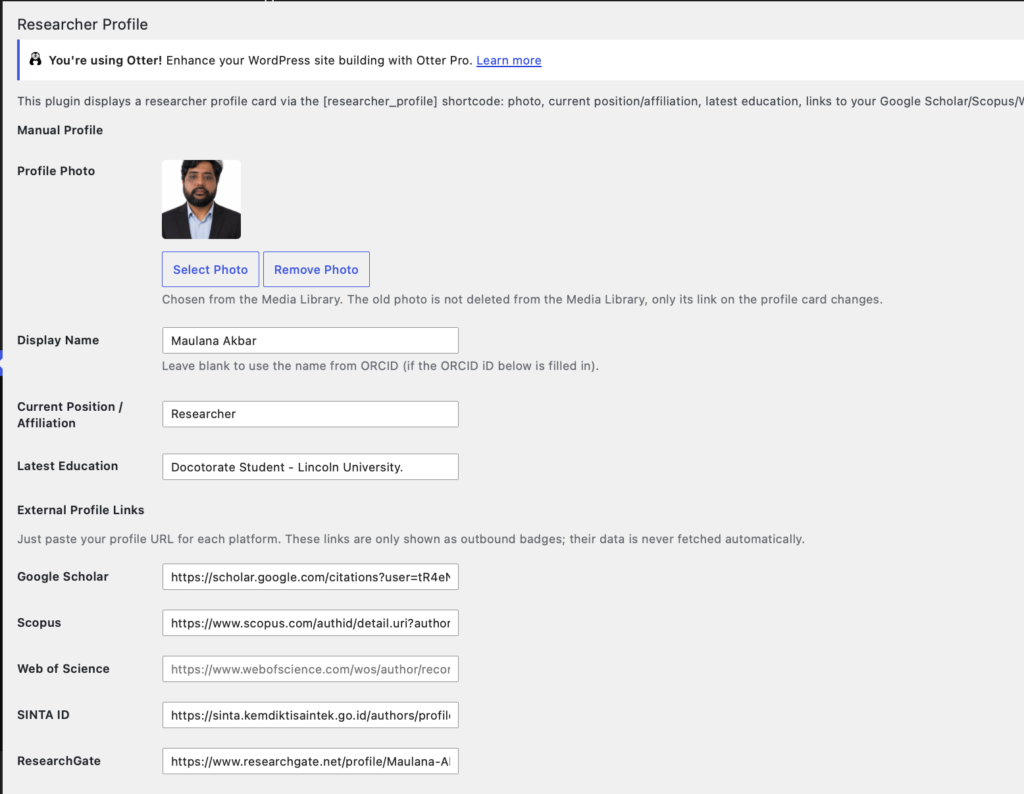
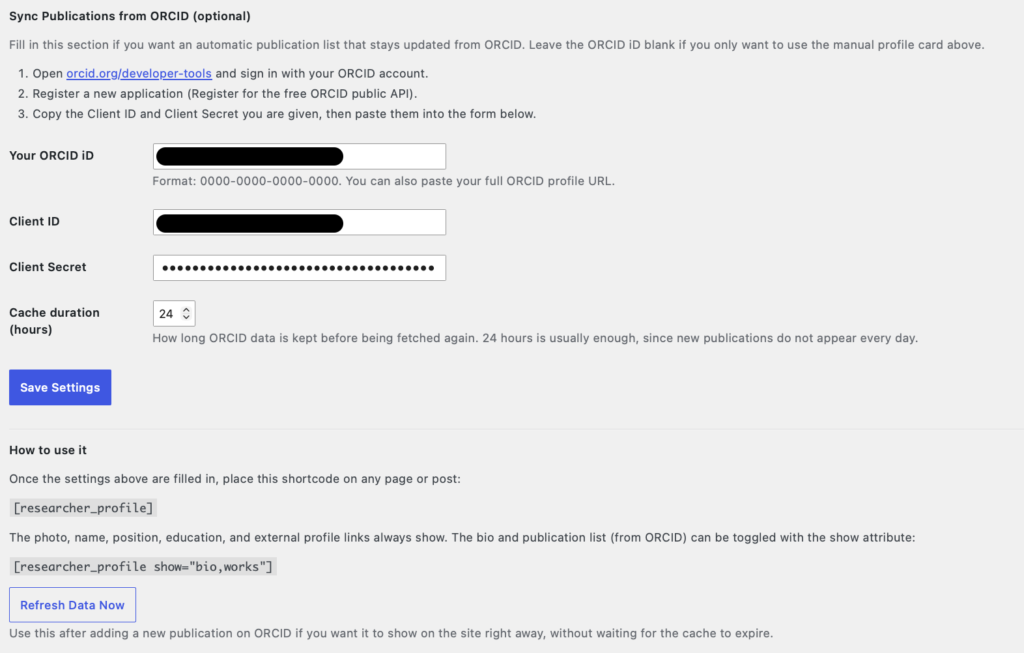
Once the plugin is installed and activated, every setting lives in one place, Settings > Researcher Profile. From there, a user can upload a photo directly from the Media Library, fill in their current position and latest education, and paste their profile links for each academic platform.
ORCID sync is optional. If a user wants the publication list to appear and update automatically, they register a free application on ORCID to get a Client ID and Client Secret, then enter those at the bottom of the settings page. Without it, the profile card still shows in full, photo, name, position, education, and external links, just without the automatic publication list.
Once the settings are filled in, shortcode can be placed on any page, and it can also be configured to show only certain sections, for example just the bio and publications, using the show="bio,works" attribute.
Who It’s For
The idea started from a fairly common need among researchers, lecturers, and research institutions, wanting a single, presentable profile page on their own website or their institution’s website, without building something complicated or depending on a paid third-party service. The plugin suits an individual researcher who wants a profile page on a personal site, as well as a research institution that wants to display several researchers’ profiles on one site at once.
Since its intended audience isn’t limited to Indonesian researchers, the plugin was built with English as the default interface language, bundled with an Indonesian translation, so the display automatically adapts to whatever language the installing WordPress site is set to.
Leave a Reply